Monthly Archives: November 2015

Officer Training Corps

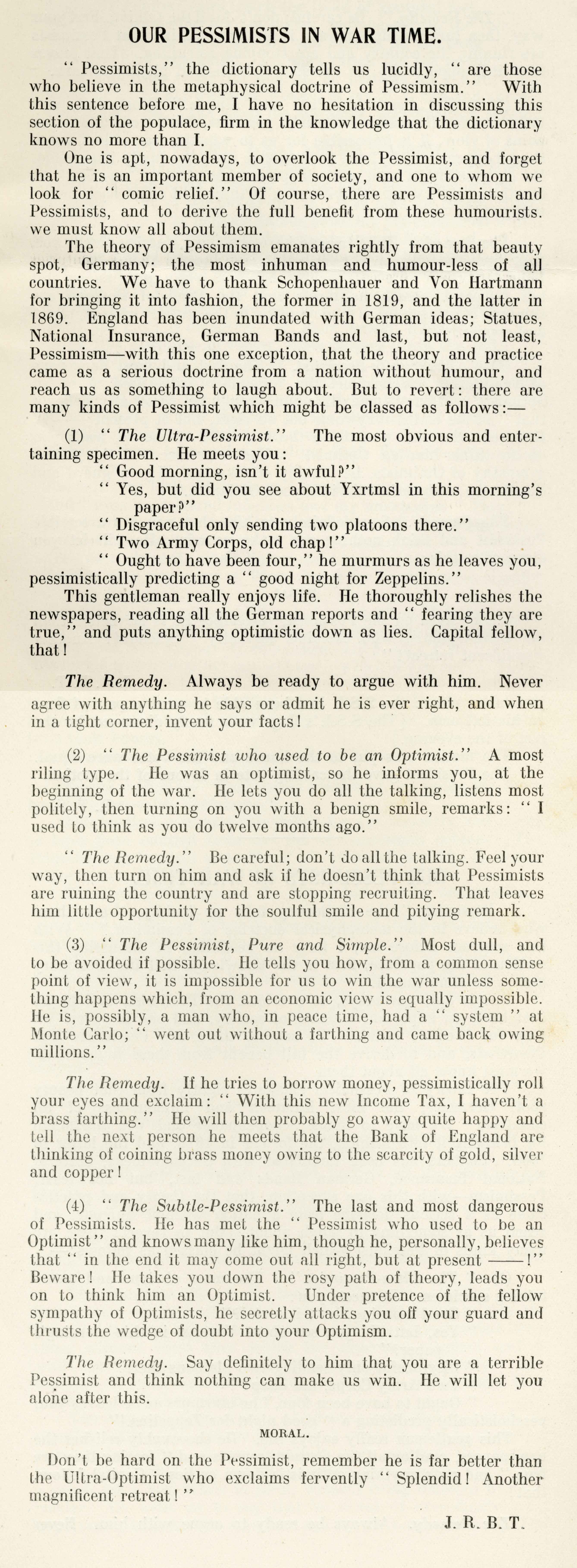
PARADES take place this term on Mondays, Tuesdays, and Fridays. The Friday Parade is devoted to Company drill, the platoons being organized in houses. Much practice has been obtained in close order company drill by those Cadets who are leaving, and we think that they have improved a good deal. It appears that they are better in the position of Company Commander than in that of Platoon Commander, and we should like to suggest that they devote more of their attention to the perfecting of their words of command in the latter position.

The Monday and Tuesday Parades are carried out under House Commanders, the system working side by side with that of football house leagues. This is the arrangement we have had before in the Lent term, and its popularity has justified its working also in the Play term. All the same, the C.O. does not bind himself to adhere to this system always, nor even for the whole of this term.

Shooting has been in full swing on the Tufton Street miniature range, kindly lent to us on three days a week by the Royal Fusiliers. It is hoped that our time may be extended to four days a week before very long. Much as we appreciate the kindness of our neighbours in placing this range at our disposal at certain times, we look forward somewhat vaguely, but none the less anxiously, to the time when we shall have our own range. The vast amount of shooting which has to be got through at our present strength would be much more easily organized if we could have a range entirely under the control of the Corps.

A Field Day was arranged against Cranleigh for Thursday, October 28. We hoped to go down to Chilworth and carry out some manoeuvres on Blackheath—our usual battleground. We woke up to the sound of dripping rain, which had evidently been going on most of the night. It was wisely decided to cancel the arrangements, and we now have the event to look forward to. The date, as far as we know, is not refixed, but we hope to have better luck with the weather next time.
Posted in Home Front | Tagged | Leave a comment

America’s behaviour during the War has been unjustifiable

The House met on Thursday, November 25, to discuss the motion ‘That in the opinion of this House America’s behaviour during the War has been unjustifiable.’

The Proposer (The VICE-PRESIDENT) said that he proposed the motion on two grounds that her acts all through had been double dealing, and that she had not fulfilled her role as a party to the Hague Convention. The Red Cross had been violated by Germany, open towns bombarded, neutral shipping destroyed, and non-combatant civilians had been murdered, but America’s only reply had always been a useless Note.

The Opposer (Mr. GREIG) said that America had done her best in sending Notes to the Germans when they violated the Hague Convention. Her army was very small and her navy, though of a good size, was not well manned. America, he said, was half German, and it would be very difficult for her to come in on either side.

The Seconder (Mr. HOLLINS) said that there had been no complaints about Germany’s barbarism in Belgium. The Americans had been very slack with regard to the various German officials in America who had been plotting to blow up their munition works. America ought not to interfere with European affairs.

Mr. KIRKMAN pointed out that we had all invited the American Ambassadors to look after our affairs in enemy countries, and this was asking America to interfere with European affairs. Her best way of looking after our affairs was to send Notes, for her army and navy were both weak.

Mr. SHARPE called our attention to the resignation of Mr. Bryan.

Mr. MEYER said that America’s whole principle was wrong. They should take proper action, and not be a mere Note-sender.

Mr. BRANDON-THOMAS said that America was not a first-class power, and should not try to be one.

Mr. HERBERT said that she would ruin herself with internal strife if she went into the war.

The PRESIDENT said that no one had dealt with the amazing statements of the Opposer and fourth speaker. America had failed in her dutyto the world. Self-interest was not the only thing. Her only hope lay in a big upheaval.

After various quarrels of a more or less personal nature, the motion was put to the vote, and carried by 10 votes to 6.

Posted in Debating Society | Tagged | Leave a comment

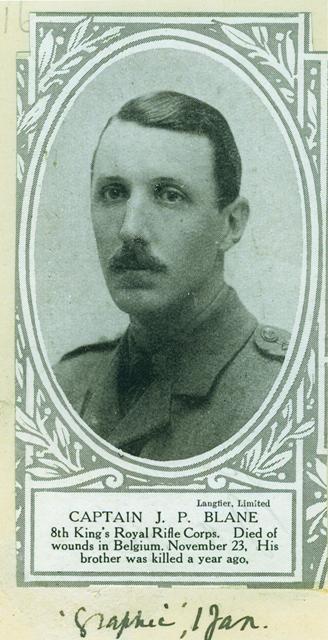
James Pitcairn Blane

19151123_Blane,JP

James Pitcairn Blane was in Ashburnham House from May 1895 until July 1901. He was a keen cricketer and played in the school’s XI with the highest batting average in the team of 24.0. When he left the school he became a mining engineer, spending four years in Western Australia and travelling to West Africa on several occasions. On the outbreak of war he was the manager of a mine in Cornwall. He joined in the 8th Battalion of the King’s Royal Rifle Corps in October 1914 and went out to the western front in May 1915.

Blane was seriously wounded at 5pm on 19th November whilst to the left of the B16 trench to the north-east of Ypres. He was hit by a ‘whizzbang’ the nick name given to German field artillery shells. The name derived from the fact that the shells fired from German 77mm field guns travelled faster that the speed of sound and therefore soldiers heard the ‘whizz’ of the shell travelling through the air towards them before the ‘bang’ issued by the gun itself upon firing. The result of this high velocity was that defending soldiers had very little notice of the incoming shell. Blane was taken to the nearby military hospital in Poperinghe but died in the early hours of the morning of 23rd November.

His younger brother, Hugh, died in active service in 1914 and his elder brother, Cmdr Sir Charles Rodney Blane killed in action at the Battle of Jutland in 1916.

Blane had played cricket for MCC and is also commemorated on the club’s roll of honour.


Posted in The Fallen | Tagged , , , , , | 2 Comments

Britain’s unreadiness for the War was entirely due to the negligence of the Government, continued

The House met on Thursday, November 18, to continue last week’s debate.

Mr. HARROD quoted the President as demanding that England should have been told, so that her armaments might have been increased ; but he held that that policy would have been fatal, for they would have inoculated us with the desire of war, and an outburst would have been the inevitable result. And what good could such information be to the average Englishman, when it was no good to the Government ? We could never have caught up Germany’s military supremacy, and an exhausting struggle in armaments would have been the only result, whereas the Government saw our proper sphere was in the struggle for industrial supremacy. Mr. Harrod then attacked Mr. Brandon-Thomas’s speech, especially his exercises in invective against Ministers. Mr. Brandon-Thomas demanded something theatrical, but he was content with the solid virtue and far-sightedness of the Government. Mr. Harrod is rather apt to repeat himself.

The VICE-PRESIDENT then rose and attacked most of Mr. Harrod’s statements. He pointed out that efficient mobilisation was due to a General Officer, and declared that nothing could have been worse than Lord Haldane’s administration of the War Office. He also quoted our lack of munitions as pointing to negligence on the part of the Government.

Mr. BRANDON-THOMAS then defended himself against Mr. Harrod’s attacks, chiefly by the use of an all-embracing ridicule.

Mr. OLIVER scoffed at the idea that the eight battalions removed by Lord Haldane were of any use. He thought it would be tyrannous if the nation has to support a large army and a large navy.

The PRESIDENT deprecated the attacks on Lord Haldane, who simply did not realise that Germany had changed since the time of Hegel. As for the impossibility of catching Germany up, Germany had got the start ; because she had got the start she was at the end of her resources, whereas Britain had not began to draw on them. Lord Roberts was a brave man, speaking the truth ; the Government insulted him. The democracy was told by its leaders that there was no danger when there was danger. For the want of a little courage and few more men, Belgium had been ravaged and made desolate. Could a Christian believe all this necessary and right?

Mr. GERRISH got up and started the old question by declaring that Britain had a Navy which was quite sufficient for her needs.

The PRESIDENT declared that it was not sufficient for the needs of Europe.

Mr. HARROD brought the debate to a conclusion by pointing out the inconsistencies in the speeches of the Vice-President and Mr. Brandon-Thomas, and accused the latter of getting hold of a piece of a phrase and making great fun of it, while completely avoiding the point.

The motion was then put to the vote, and lost by 7 votes to II.

Posted in Debating Society | Tagged | Leave a comment

London in War-Time

EUSTON at last ! The old, pale sunlight falls
Golden athwart the smoky roofs and walls,
Again the well-loved streets and Thames we see,
And five weeks’ mountains are a memory.
There is a glen that nestles in the hills,
Lit by the flashing of unnumbered rills ;
Through it a path goes winding under trees
That gaze unmoved upon the centuries ;
And from the summit the clear sunlight calls
Athwart the undying chuckle of the falls.
Safe at the top I stayed my climb and pondered
Not on the sunlight that divinely wandered
Among the trees and danced upon the stream,
Sighting a fairy lamp at every gleam,
But seeing the branches bending overhead
So like to vaulting well remember├®d,
I felt the gloom and heard the quiet stir
That soothes the tired soul at Westminster.
The young Gods made the country, took delight
In quiet fields and great, calm stars at night.
But then came One who saw with steady soul
That quiet could not be the final goal ;
And He brought men together, made them strive
To hate, to love, to help, in short to live.
God made the Town, and high above the rest
London with all his various gifts he blessed.
But now the posters shriek from every wall,
And false lures call where Honour ought to call ;
In flaunting headlines mixed of lies and spite
The Press most nobly vindicates its right,
‘The Nation’s Voice with its stentorian lungs ;
The Nation seems to have a hundred tongues.
Its tongues are loud ; its boastings high and bold.
Surely the Nation’s heart is worn and old.
Fool, these are straws that shew the flood beneath
Inevitable as night and sure as death.
Are we awake ? See, o’er the darkened sky
The searchlight’s darting and imperious eye.
While down below discreet and scattered lamps
Shew where the lonely ‘Special ‘ stoutly tramps.
Is our heart stirred ? See, when the trains arrive
With erstwhile men now pitifully alive,
The sun’s not up, but London’s daughters are,
That once would shiver at a penknife’s scar ;
Or in the street the brown-clad men go by,
The woman’s prayer, the old man’s wistful sigh,
Mark you them not ? And ever more and more
The pulse beats faster than it beat before ;
Before each bridge and every thick-thronged street
Was trod, ’tis true, with eager, hurrying feet,
But then on different business each was bent,
See, now on every face the one intent ;
The will’s the same, whate’er the work may be,
Each face means fiercely ‘Victory, Victory.’
London before was somewhat hard to find,
Shreds showed themselves to some in every mind ;
Now she is bound together and made whole.
The price is bitter, very hard the toll,
But none may crush her, she has found her soul.

C.L.B

The Elizabethan, November 1915

Posted in Home Front | Tagged , | Leave a comment

Britain’s unreadiness for the War was entirely due to the negligence of the Government

The House met on Thursday, November 11, to discuss the motion’That in the opinion of this House Britain’s unreadiness for the War was entirely due to the negligence of the Government.’

The Proposer (The PRESIDENT) said that it might seem presumptuous for schoolboys to discuss such a motion, but he considered that the members of the House formed part of a most valuable class in Society. Before he dealt with the question he asked the House not totreat it as one of party politics, for it only happened that a Liberal Government was in power. He conceived that he had three things to prove : That there was danger; that we were unready; that the Government saw the danger, The ‘first needed little proof in the light of what we know now, though some may have known of the literature of Anglophobia, semi-official in character, published in Germany. As to the second, the President said that the mere fact that only two thirds of our expeditionary force was sent across at first would prove it, but even our full Expeditionary Force was absurdly inadequate, as every eminent soldier knew. But most of all we were morally unprepared. Now the Government had had six distinct warnings. The Morocco incident, where Germany tried to break the Entente ; the acceleration of the ‘German Naval programme in 1908 ; the third warning in 191o, of which little was known ; the famous Agadir incident ; the extraordinary mission of Lord Haldane, which fully enlightened the Government, according to Mr. Asquith ; and, lastly, the German Army Bill and Loan of 1913. This last showed that Germany’s best hour to strike would be somewhere in the year 1914, when we were being told that we were on the best terms with Germany, and when Lord Roberts was being insulted in Parliament for telling the truth.

The Opposer (Mr. ABRAHAMS), in a short speech, said that he fully admitted the President’s three points, but contended that nothing else could have been done. The Government received from their predecessors the ideals of Peace, Retrenchment and Reform. The Imperial Defence Committee had advised that no form of National Service was necessary, and no one of either party listened to Lord Roberts. The majority had always been against a large aimy, and while the Government were trying to get such an increase, as the President suggested, sanctioned by the people, Europe would see what was up, and Germany would attack us. The fault lay not with the Government, but with English history.

The Seconder (Mr. BRANDON-THOMAS), in a fluent but rather irrelevant speech, began by comparing the Opposer to Parliament, which always does what their forefathers did, and then blames them. We ought to have learnt our lesson from the Boer War, but we didn’t, and all our armchair critics laughed at Lord Roberts. The Government was always leaving things to be done afterwards, so they never got done at all. In peace they refuse to listen to the demands of the War Office and the Admiralty ; and when war finds the country unprepared, they are offered up as a scape-goat. The Government was always afraid of something—of the people, or of Germany, or of itself. Mr. Brandon-Thomas drew a, glowing picture of the elder Pitt’s measures, and proceededto deliver a venomous attack on Lord Haldane. He finished by saying that the Government had always crushed patriotism, and were horrified at any lack of it when disaster came.

The debate was then adjourned till the next meeting.

Posted in Debating Society | Tagged | Leave a comment

Kenneth Theodore Dunbar Wilcox

19151108_Wilcox,KTDKenneth Wilcox was the only son of Rev. G.A. Wilcox, who was the vicar of St George’s Battersea Park and who had previously been temporary chaplain to the forces. Kenneth was admitted into Homeboarders’ in May 1905 for a year.

He sat the Challenge over the 23rd, 24th and 25th June 1909 and was elected a resident King’s Scholar. He was a strong member of the Junior College Football team in 1911. The house notes recall that “KTD Wilcox led our Juniors to victory over Rigaud’s, and at present looks like repeating the performance at the expense of Homeboarders”.

In July 1913, he was elected to an exhibition at Christ Church, Oxford, and matriculated the following Michaelmas term. He did not finish his degree, however, because in less than a year he had enlisted in the Public Schools Battalion, Middlesex Regiment. The Public Schools Battalions were set up for former public schoolboys who wanted to fight as soldiers beside their friends, rather than serving as officers. In October 1914, he became 2nd Lieutenant in the 8th Battalion Queen’s Royal West Surrey Regiment and went out to the western front on the 8th October 1915.

Exactly a month later, Kenneth Wilcox was fighting just south of Ypres at Lankhof Farm — sometimes also known as Lankhof Battery —a cluster of bunkers, which can still be seen today. He was killed there at the age of 20 and is commemorated at Chocques Military Cemetery. His obituary in the Elizabethan tells us that he “died of wounds on the Western front, and was laid to rest by his father”.

Posted in The Fallen | Tagged , , , , , , , , | 1 Comment

The Press has done more harm than good during the War

THE House met on Thursday, November 4, to discuss the motion’That in the opinion of this House the Press has done more harm than good during the War.’

The Proposer (The SECRETARY) said that the Press had criticised and attacked many of theleading statesmen of Britain, and had given a great deal of information to our enemies, and neutral countries believed a great deal of what the Press said, as the British Press was quite different from that of other nations; and it created a very bad impression in neutral countries when our Press criticised our politicians. The French newspapers had been reduced to one page of official news. Could we not do this in England ?

The Opposer (The VICE-PRESIDENT) said that the Secretary’s main point was the effect upon neutrals. He denied that the Press had any effect upon them. They got their news from reliable sources. All newspapers were censored. It was no fault of the Press what news was published. The Secretary had scoffed at the articles by the various Naval and Military correspondents, but these, after all, were only the views of one person, who knew a good lot, who did not pretend to be a prophet, but was merely expressing his opinions. The papers, he said, had done a lot of good as regards conscription.

The Seconder (Mr. MEYER) harped mostly upon the newspaper placards. These, he said, were made in order to make the paper sell, and, to the passer-by, usually gave an entirely wrong impression.

Mr. KIRKMAN, who spoke instead of the Treasurer, who was ill, said that, judging by the number of rumours and extracts of articles from the Figaro, Matin, and other French papers which are printed in our daily papers, it was absurd to suppose that the French papers had been cut down to one page of purely official news, as the Secretary had said.

The PRESIDENT said that the Press was there primarily to be accurate, and the Vice-President himself had said that it was not accurate.

Mr. HARROD asked what we should do without a Press ? The numbers of rumours that would get about would he enormous.

The SECRETARY said that Mr. Harrod was off the point.

From here the meeting resolved into violent arguments on the subject of Lord Northcliffe.

The motion was then put to the vote, and lost by 7 votes to 13.

Posted in Debating Society | Tagged , , | Leave a comment

Slackness in War-Time

THERE have been many signs lately that seem to betray a growing slackness up Fields, a steady falling-off in the interest which should be accorded to games. This has been manifested in various ways : failure to cross one’s name out on the games’ lists, an omission which causes immense trouble ; a disinclination to play football at all on the part of the boys high up in the School ; a wretched attendance, or rather lack of it, at matches, and, as a correspondent points out in this issue, a painful lack of enthusiasm in those who are on the ground, which contrasts vividly with the interest and excitement displayed by the ‘railings.’

This spirit may be charitablyattributed to the War, the universal scapegoat. It is hard nowadays to concentrate even on work, when other work is going on elsewhere that seems so much more engrossing, so much more vital. And it is certainly doubly difficult to find the necessary enthusiasm and energy for games ; indeed many acutely feel the incongruity of their employment when they go up Fields in footer’ change, and have to pass along Victoria Street with its ample numbers of men in khaki, and perhaps a recruiting sergeant hovering near. Now we can only do this without misgiving, and we can only play games as they should be played, with heart and soul, if we are obsessed by the conviction that we are doing the right thing ; and there is no doubt that we are doing the right thing.

If there is one thing this War has made manifest, it is the worth of that much-maligned being, the Public School Man. We cannot be accused of undue pessimism, we think, when we say that the Public School Man is still in great demand, and is likely to be for some considerable time. Therefore the supply must equal the demand. ‘Very true,’ says our advocatus diaboli, ‘but are games necessary at the present time ? ‘We might content ourselves with pointing out that games are an integral part, and no unimportant one, of that system which has produced the men who are so lightheartedly and efficiently officering our armies. But what else can be suggested in their place ? Some form of physical exercise is necessary, especially in London. What about the corps ?’ says our imaginary opponent with commendable promptitude; let us devote all our energy to that, and play no games at all.’ Now this is a specious argument, and the rejection of it would seem to imply a lack of patriotism ; but we do riot think it sound or practicable, although such questions of course must eventually rest in other hands than ours. If we were in the country, and could devote unlimited time to field work, or even if we were so efficient in our drill that we could pay proper attention to physical exercises, then perhaps the question might be considered. By all means take every care that games do not interfere with military duties, which must be paramount nowadays, but, nevertheless, carry on with the games.

All of us, no doubt, have marvelled at the popular catch-word, ‘Business as usual,’ and thanked God that England has not been doing her business as usual during the past year. No ; our duty is to do our business with ten times more zeal than usual, with ten times more energy, with ten times more conviction.

And let us not be deterred by its nature. Whether it be military duties, the most congenial business, or work in School, which is work after all, as we, no doubt, say subconsciously to ourselves, but also if it be games, let us put our whole soul into it, as surely as some day we hope to put our whole soul into a grimmer and more exacting game.

From The Elizabethan, November 1915

Posted in Home Front | Tagged , , | Leave a comment