Monthly Archives: June 2018

Henry Lionel Storrs

Henry Lionel Storrs was the second son of Harry Townsend Simons Storrs, Head Master of Shirley House Preparatory School and his wife Clara. He attended his father’s school, before obtaining a King’s Scholarship to Westminster in 1912. Henry was actively involved in many elements of school life. He won his full pinks for rowing, was a corporal in the school’s Officer Training Corps, and helped his house with the Singing Cup in his final year at the school. His obituary in The Elizabethan noted that his ‘high character was thoroughly appreciated’ at the school.

In 1916, Henry was elected to a scholarship at Trinity College Cambridge with both Triplett and Samwaies prizes. However, instead of going to University, he took a commission in the Royal Flying Corps in August of that year. He first went out to France as an observer in January 1917. In July of that year he returned to train to become a pilot, completing his course in November. In December 1917 he returned to France and served successfully until June. On 15th June he was wounded in a fight with ten enemy aeroplanes, but managed to make his way back to allied territory and to safely land his aircraft in the aerodrome. He was sent to the Duchess of Sutherland’s Hospital, near Arras where he died on pneumonia five days later.
Posted in The Fallen | Tagged , , , , , | Leave a comment

Edward Alexander Morgan Bindloss

Edward Alexander Morgan Bindloss was the son of Reverend Edward Bindloss and his wife Maria, whose father was from Russia. He was born in 1875 and joined the school in Homeboarders house in 1888. He left, just under four years later and we do not know what he did for the following 11 years. In 1903 he became an Associate Member of the Institution of Civil Engineers and he worked as an electrical engineer in Newcastle-upon-Tyne and Birmingham in subsequent years.

Edward served in the South African War with the Northumberland Fusiliers and took that rank of Lieutenant in 1902. He married Margery in 1909. In 1912, he became a Captain in the 5th Battalion of the Royal Warwickshire Regiment.

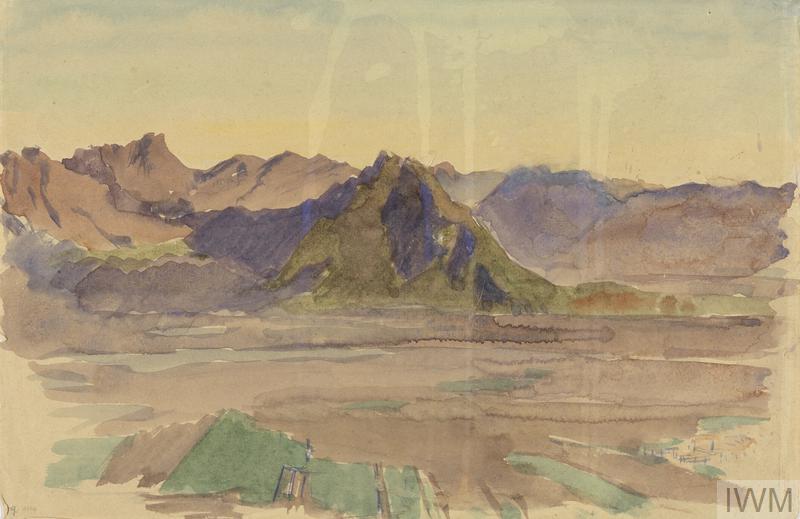
When war was declared the 5th Battalion immediately mobilised. In March 1915 the force travelled to Le Havre and were here incorporated into the 48th (South Midland) Division. This Division took part in numerous battles on the western front over until November 1917, when they were transferred to Italy. Here they were involved in fighting on the Asiago Plateau on 15th and 16th June. It was in this battle that Edward lost his life. He was survived by his wife and daughter, Dorothy.

Aerial View over the Asiago Plateau, Italy, 1918 by Sydney William Carline Copyright: © IWM
Posted in The Fallen | Tagged , , , , , , , | Leave a comment

John Ernest Vivian Rathbone

Rathbone was a well-liked pupil whilst at the school. He joined Ashburnham House in May 1911 and stayed at the school until the age of 17, leaving at Easter 1915. The Elizabethan records that ‘he showed great energy and in his regiment he was a very effective and particularly popular officer. At School he was a football Pink and Company Sergeant Major in the Corps.’ He was also active within his house, serving as a monitor in his final year. His Head of House recorded in the Ashburnham ledgers that it was ‘…clear that Rathbone was a really good chap and I liked him immensely. He was senior NCO in the corps his last term and he did a great deal for the House in this line. He was immensely keen on all games. He was rather wild in his nature… he was however, I believe a true sportsman out and out.’

On leaving school Rathbone joined the Inns of Court Officer Training Corps. He received a commission as a 2nd Lieutenant in the 3rd Battalion of the Dorset Regiment in June 1915. He was severely wounded at the Somme in July 1916 but quickly returned to the front. He was killed in action near Arras in 1918.

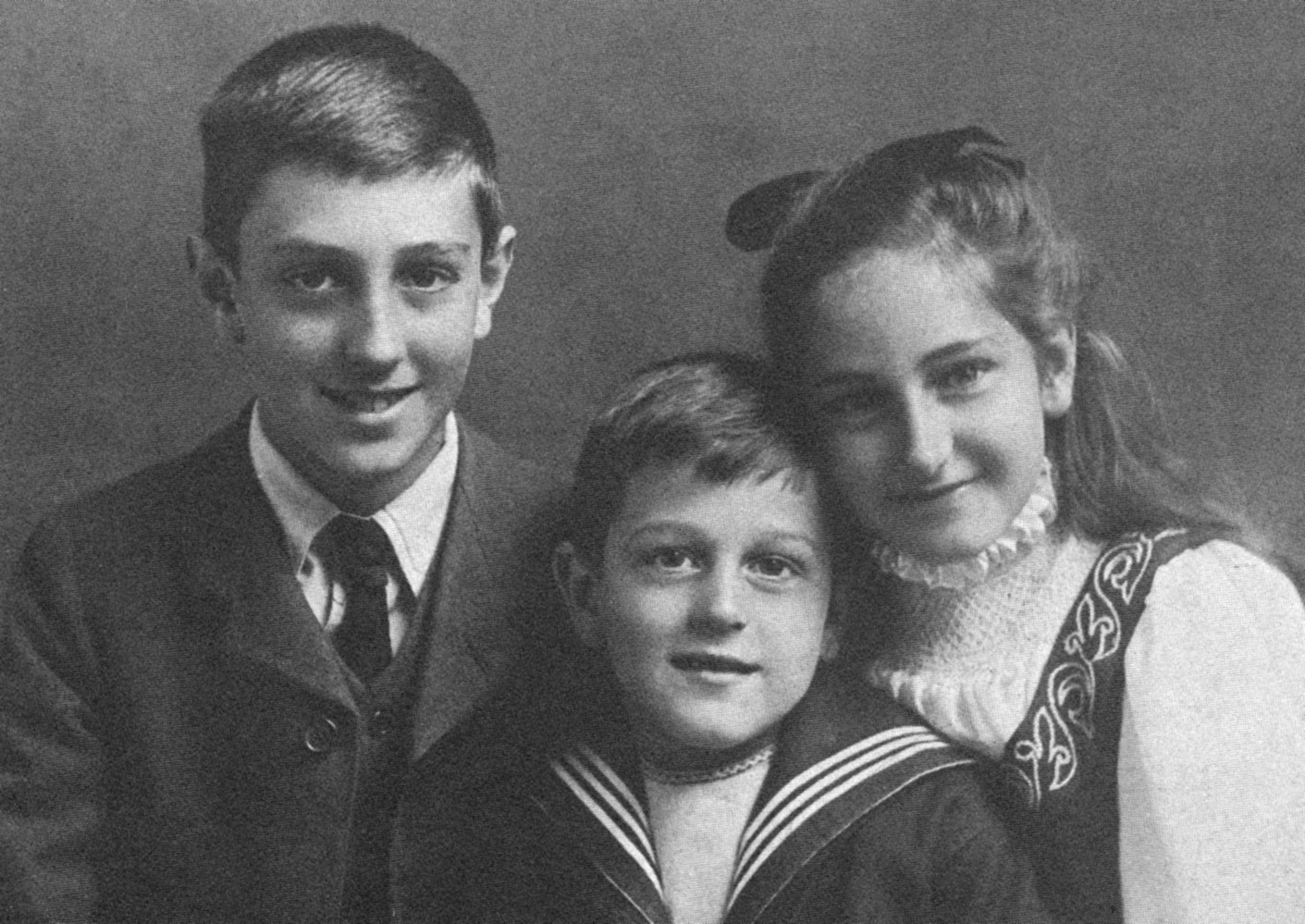
Rathbone was the younger brother of (Philip St John) Basil Rathbone, who survived the war and found fame as an actor, perhaps best known for playing Sherlock Holmes. When asked about his brother’s death in later life, Basil stated that he had instinctively felt his brother’s death at the moment that he was killed. He wrote the following passage in a letter to his family on 26th July 1918 following John’s death:

‘You ask how I have been since we heard, well, if I am honest with you, and I may as well be, I have been seething. I was so certain it would be me first of either of us. I’m even sure it was supposed to be me and he somehow contrived in his wretched Johnny-fashion to get in my way just as he always would when he was small. I want to tell him to mind his place. I think of his ridiculous belief that everything would always be well, his ever-hopeful smile, and I want to cuff him for a little fool. He had no business to let it happen and it maddens me that I shall never be able to tell him so, or change it or bring him back. I can’t think of him without being consumed with anger at him for being dead and beyond anything I can do to him.’

John Rathbone, centre, with elder siblings Basil and Beatrice.
Posted in The Fallen | Tagged , , , , , | Leave a comment

Leslie Grantham Heigham-Plumptre

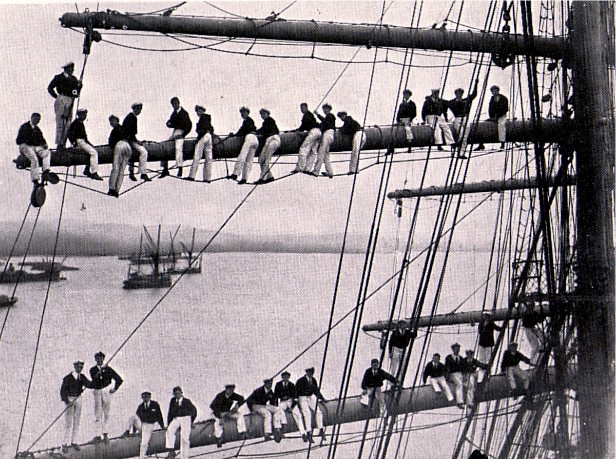
Leslie was the son of J.V.N. Plumptre and Mary Ling. He was adopted by Henry Heigham and adopted his surname in addition to that of his father. He joined the school aged just nine years old from Shrewsbury House Preparatory School. He started initially as a day boy in Ashburnham in 1907 and then became a boarder in Grant’s. Leslie left in Easter 1913, then aged fifteen, and joined HMS Worcester. The ship was the home of the Thames Nautical Training College and cadets received training with a view to becoming seamen in the navy.

Leslie’s career took him in a different direction and he joined the Royal Military College, Sandhurst in 1917 before taking a commission as a 2nd Lieutenant in the 3rd Battalion of the Bedfordshire Regiment in September 1917. In December he was attached to the Royal Flying Corps, and he went out to the Western Front in March 1918. Eleven days after arriving, he was wounded and invalided home, but he returned to the front on 19th May. Once again, less than a fortnight after arriving he was injured in a bombing raid. He died from his wounds on 4th June 1918.

Cadets on HMS Worcester, early 20th Century
Posted in The Fallen | Tagged , , , , , , , | Leave a comment